
Four phases, not one weekend
The immersive part is the middle of the course, not the whole of it. Here is the sequence, from the first free session to the point where you no longer need a tutor.
Home > Formative Offer > Learning Skills > LEARNIS Mind > How It Works
Phase one · The free presentation
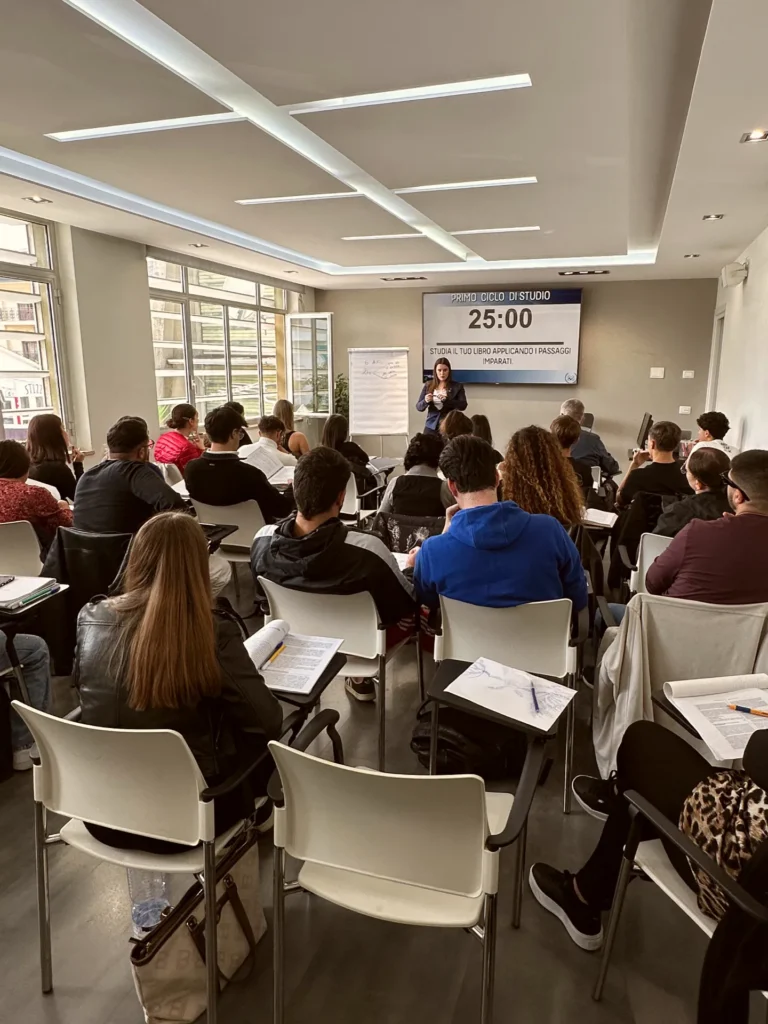
It is free and it lasts a couple of hours. Three things happen, and the first one involves you doing the work.
You memorise a sequence of eighteen words. It takes about ten minutes and, for most people, it works — because you were asked to use your memory differently. That is why it comes first: the problem had a cause, and the cause was method.
Then you watch. Former participants or staff run two demonstrations: a longer sequence with a long number, and then a real magazine article. What they show is what becomes possible, and the question that follows: how would this work on my own subjects?
That is what the course answers.
Phase two · Profiling and preparation
Before the immersive part there is individual work, and it is the phase most people do not know exists.
The AMOS battery — published by Erickson — describes in depth how you study today: the strategies you actually use, how coherent your method is, how you organise yourself, what you believe about your own intelligence and how you handle anxiety. You get an individual read-back of the results, and it is the picture the rest of the path works from.
Then comes the Ora Zero, an individual session with your tutor. You set your objectives, and somebody starts building something around your specific situation.
Phase three · The immersive weekend
This is the core of the course and the part everyone has heard about.
What changes here is scale. Techniques of strategic learning, the ALCUORE sequence that organises the whole process of studying, exercises that make visible steps you were performing automatically or confusedly, and a group of people working on the same thing at the same time.
It is intense by design, and it is one phase of four.
Phase four · The months that follow
The general method becomes your method here, on your own materials.
One-to-one tutoring is the centre of it: a first package of seven hours, to be used within ninety days of the weekend. The tutor works on how you approach the material — the strategy, not the syllabus. Where you also need help with the subject itself, that is a different service and is agreed as such.
Alongside it: strategic reading, which extends the method from memorising to processing; continued training on the fundamentals; guided practice, the community, and customer care that checks whether the thing is holding. The course materials, the app and the learning platform keep the work in one place between sessions.
For twelve months from your first participation you can also re-attend the course in the network's centres, as scheduling allows. Most people use it when something changes: new subjects, a different school, university.
The intended end point is straightforward. You need your tutor less and less.
One difference between countries, worth knowing before you book
The four phases above describe the course as it is delivered in full. In Spain one module is not yet part of it: the comprehension module developed with CNR-IRPI researchers together with the SaperCapire team is being adapted for the Spanish network and is expected within a few months.
Until then the course runs in Spain in its previous form — the version thousands of people have already done — working on the same abilities: reading, organising, recalling, and noticing which of those is failing. The Learnis organisation in your country will tell you exactly what the current edition includes.
What happens inside you, phase by phase
- Relief — the problem had a cause, and the cause was not you
- Possibility — if it works like this on words, it can work on my subjects
- Self-knowledge — I can see how I actually learn, and where it breaks
- Preparation — somebody is building something around my situation
- Immersion — the experience changes scale
- Application — the method meets my real materials and adapts to them
- Autonomy — the method is mine, and it stays after the course ends
Phase one costs nothing
The presentation is free and you do not have to decide anything at the end of it. You will have done one exercise yourself, which is more than any description can give you.